



Introduction
Garlic is a profitable crop, often the first choice for farmers. However, planting garlic can be troublesome, as it requires constant bending over to place garlic cloves in prepared holes, which is very tiring. A garlic planter solves this problem. In this article, I will introduce the garlic planter and provide some tips for buying one.

What Is a Garlic Planter?
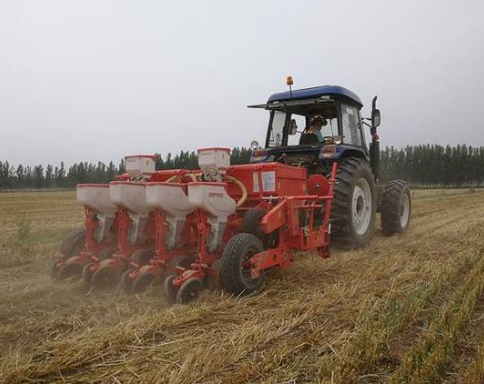
The garlic planter is an agricultural machine designed for large-scale mechanized garlic cultivation in both flat and hilly areas. It separates garlic cloves and sows them evenly in the field at a defined spacing, row spacing, and depth. It replaces manual spot sowing, ensuring uniform arrangement and depth of garlic cloves, improving seedling emergence and labor efficiency. It is typically used in conjunction with small or medium-sized agricultural tractors. The garlic planter utilizes a series of mechanical components and a power system to automate the garlic planting process.
Types of Garlic Planters
With advances in technology, garlic planters have improved and evolved to meet farmers’ needs.
According to the sowing method
Ordinary Garlic Planters
Traditional garlic planters are horizontal, planting garlic cloves in a horizontal or nearly horizontal position. The commonly used scoop-type planter is effective for seed collection and placement, but lacks the ability to actively adjust and correct the position of the garlic cloves, causing them to lie randomly. This can lead to uneven seedling emergence, delayed emergence, and weak growth. Ordinary garlic planters use a horizontal seeding method.
Upright Sprout Garlic Planters
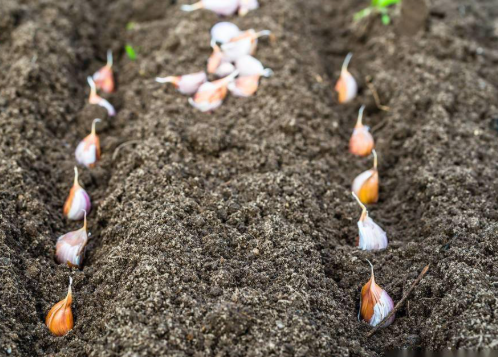
A straight-bud garlic planter plants garlic cloves in the soil in the correct upright or nearly upright position, with the bud tip facing upward and the root plate facing downward. This typically uses a special tapered spiral guide tube. Gravity and friction force the cloves’ roots downward, allowing them to slide upright for planting. Some machines also use air suction to capture the garlic’s root plate, forcing the garlic to plant in an upright position with the root bud tip facing upward. Straight-bud planting ensures rapid and uniform seedling emergence, eliminating the need for additional energy to correct the seedling position. This ensures a solid foundation for high yields and is the ultimate pursuit of seeding technology.

According to the operating method
Based on the operating method, garlic planters can be divided into hand-push type and tractor-trailer type.
Hand garlic planter
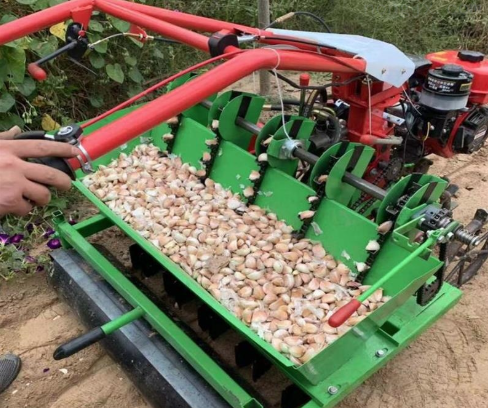
Hand garlic planters require manual pushing and are generally self-powered, with planting driven by their own power source. These planters are simple in structure, moderately priced, produce high-quality seeds, and are 5 to 10 times more efficient than manual planting. It has higher requirements for land flatness. Hand-push garlic planters are suitable for small farms and professional growers.
Tractor garlic planter
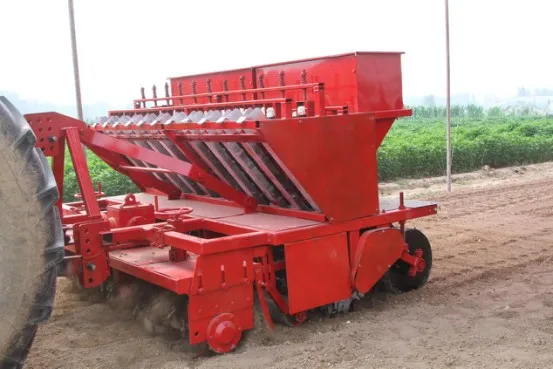
Tractor garlic planters use a tractor for traction and power output, offering a higher degree of automation. Connected to the tractor via a three-point suspension system, they replace manual planting, resulting in higher efficiency, more consistent seed quality, and minimal labor intensity. They can complete multiple tasks such as furrowing, planting, covering, and compaction in one operation. Tractor-drawn garlic planters are suitable for large-scale farms or cooperatives.
How a Garlic Planter Works
Parts of a Garlic Planter
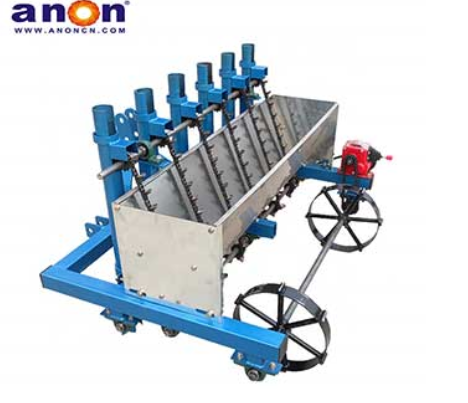
A garlic planter consists of several parts, including the seed box, conveyor, furrow opener, tapered wheel, transmission chain, gears, ground wheels, and frame.
Seed Box: Stores the garlic cloves to be planted. It is designed to hold enough garlic for long periods of continuous work.
Conveyor: Made up of chains and seed scoops, it moves the garlic cloves from the seed box to the planting position, ensuring smooth planting.
Furrow Opener: Usually two round disks create furrows for the seeds, ensuring the garlic goes into the right depth of soil.
Tapered Wheel: Found on upright sprout planters, it keeps the garlic cloves in the correct orientation as they move through the planter, improving planting quality.
Gear and Transmission System: Connects the moving parts, such as the tapered wheel, to ensure the machine operates smoothly.
Ground Wheels: These provide the necessary friction to move the planter forward while operating other parts.
Covering Device: Also called a soil coverer, it covers the garlic cloves with soil after planting, ensuring they grow properly.
Working Principle of a Garlic Planter
Hand garlic planters are propelled by human power and rely on the rotation of ground wheels to transmit power to the planting device, or they can be self-powered.
Tractor garlic planters use a PTO (Power Towing and Rotating) system to drive all working components, including seed metering and furrowing, ensuring that the planting speed is strictly synchronized with the tractor’s forward speed, thus achieving uniform plant spacing. Their workflow is highly integrated, allowing for continuous completion of multiple processes such as furrowing, sowing, covering, and compaction in one operation. For upright-bud garlic planters, the garlic cloves are guided through a conical spiral seed tube, which helps ensure that the cloves are planted facing upwards. After sowing, a covering device buries the cloves in the soil.
Advantages of Using a Garlic Planter
Improved Efficiency
A garlic planter can significantly improve planting efficiency. Traditional manual planting is time-consuming and labor-intensive, whereas a garlic planter can plant much faster. Some planters are more than 15 times faster than manual planting. For example, using a planter can save 4 to 5 days of manual labor per acre.
Save Manpower and Resources
Using a garlic planter reduces labor intensity. While traditional methods require farmers to plant and cover the soil by hand, a garlic planter can perform multiple tasks like furrowing, planting, and covering in one go. This reduces the overall labor load. While the initial investment and maintenance of a garlic planter can be costly, it saves a lot of money in the long run. The precise planting capabilities of a garlic planter can also save you garlic seeds and prevent waste. For example, in China, using a planter can save labor costs of 400–500 yuan per acre, and better planting quality can lead to higher yields and increased profits.
Increased Crop Yield
A garlic planter ensures better planting quality, which increases germination rates. The planter controls the number of seeds and the spacing between them, ensuring they are evenly distributed in the soil. This promotes healthy growth and facilitates uniform emergence and subsequent seedling management. Additionally, the garlic planter can position the garlic cloves with their roots facing down and sprouts facing up, improving seedling uniformity and survival rates, which leads to higher yields. The efficient sowing makes large-scale planting possible.
Multi-functional
In addition to planting garlic, garlic planters can also be used to plant other crops such as onions, broad beans, and saffron, making them a versatile and valuable tool for any farm. Garlic planters can improve your soil quality by reducing soil disturbance and promoting healthy root growth. Choosing the right garlic planter can help you increase productivity, reduce costs, and improve the overall quality of your crop.
Factors to Consider When Choosing a Garlic Planter
Consider Your Farm Size
The size of your land directly affects the type of planter you should choose. For large areas, it’s best to choose a multi-row garlic planter to improve efficiency. For smaller areas, a single or double-row planter would be better, as it’s more flexible and doesn’t require a large tractor, which might compact the soil.
Consider Your Soil Type
The type of soil you have will affect the performance of the planter. Different soil types might require different furrow openers and covering devices. For example, sticky soils might need a furrow opener that can dig deep and break up clumps, while sandy soils may require a better covering device to ensure the seeds are adequately covered. If you work in different types of soil, consider a planter with adjustable parts.
Evaluate Budget
The price of garlic planters can vary depending on their size and features. With a limited budget, it might be a good idea to buy a basic model and upgrade as your needs grow and profits increase.
Consider the Machine’s Performance
The performance of a garlic planter can be assessed by considering these key parameters: number of planting rows and row spacing adjustment range, plant spacing adjustment capability, planting depth control, seed box capacity, and power supply.
Firstly, the number of planting rows and row spacing adjustment range determine its planting scale. The number of rows determines the efficiency of a single operation; more rows mean higher efficiency, but also higher price and required traction. The row spacing adjustment range determines whether you can flexibly adjust the row spacing according to the variety, soil conditions, and field management habits to meet your planting needs.
Secondly, the plant spacing adjustment capability directly affects planting density and the growth space of individual plants, a core factor influencing yield. Planting depth is determined by the furrow opener and depth-limiting wheels. Planting depth affects the overwintering ability of garlic seeds, seedling uniformity, and bulb enlargement. The common range is 3-8 cm.
And thirdly, the seed box capacity determines the area you can continuously work on with one load of seeds, directly affecting work efficiency and labor intensity. A large-capacity seed box reduces downtime and is suitable for large-area operations.
Lastly, the appropriate power source is either human power, a small tractor, or a large tractor for traction; this depends on your existing power source or the power source you need to match. Choosing the wrong power source will result in the vehicle being unusable or inefficient.
Tips for Use
1. Preparations before sowing
Soil Preparation: Soil preparation is crucial for garlic cultivation. You need to ensure the soil is as loose, well-drained, and nutrient-rich as possible. Remove debris and weeds from the soil to prevent them from competing with the garlic seeds for nutrients and water.
Seed Selection: Choosing high-quality, suitable garlic seeds ensures effective planting and high yield, improving germination rates and growth conditions. Different garlic varieties have different requirements for climate and temperature; please be sure to choose garlic seeds suitable for your local climate.
Adjustment: Adjust the planter’s seed spacing and furrow depth according to the size of the garlic cloves and the desired planting depth. Proper adjustments will ensure uniform planting and optimal conditions for garlic growth.
2. Key Points for Sowing Operations
During sowing, you should maintain a constant speed and keep the machine in a straight line. Add garlic cloves promptly during the process, observing the cloves’ position in the seed scoop. If any seeds are missed or there are multiple seeds in one scoop, replant immediately, remove excess seeds, and add more garlic cloves as needed to ensure efficient operation.
3. Post-Operation Cleaning and Maintenance
After each operation, you need to clean the machine of dirt and residue, check fasteners, and lubricate moving parts. After the sowing season, clean the machine thoroughly and store it in a dry, well-ventilated place.
Conclusion
I have provided a detailed introduction to garlic planters. If you are interested in purchasing one, feel free to contact us at ANON. We are happy to offer high-quality machines and services!
FAQ
1. How long does it take for a garlic planter to plant one acre of land?
This depends on the machine’s specifications, such as the number of rows it plants. The more rows, the faster the planter can complete the job.
2. What equipment is needed for growing garlic?
Planting garlic is the first step in a long growing process. Proper seeding is the foundation for a good return. You’ll need a splitter, seeder, harvester, cleaner, grader, scrubber, and peeler.
3. What happens if garlic is planted too close together?
When planting garlic, each bulb needs ample room to grow and absorb nutrients. You need to maximize the available space in your garden. Planting garlic cloves too close together will result in stunted bulb development; planting them too far apart may result in a low yield!
4. When should garlic be planted?
The best time to plant garlic is in the fall (September to November), a few weeks before the soil freezes. This allows the garlic to take root before winter arrives, ensuring a good harvest the following spring. In warmer regions, planting can be done as late as early December, but generally, the earlier the planting, the larger the garlic bulbs. Of course, if you miss the optimal planting time, you can still plant in the spring.