



Steel Silo
Steel Silo
World-leading food storage solutions. ANON sells steel silos globally with a total capacity to store approximately 300,000 tons of grain. As a premium agricultural machinery manufacturer, we provide high-quality grain storage and preservation solutions to support the sustainable development of the grain industry.
Choose the right product for you
Providing quality products and services.
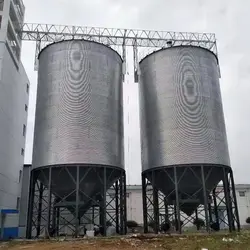
ANON’s steel silos are large storage containers assembled from high-strength steel plates using interlocking seams or bolted connections. They are suitable not only for storing grain and feed but also for bulk materials such as oilseeds, chemical raw materials, and cement. We offer various types of steel silos, including bolted steel silos, welded steel silos, and spiral steel silos.
Steel silos have become the preferred steel structure containers for bulk material storage due to their large capacity, high strength, rapid construction, and excellent sealing properties.
Bolted Steel Silos:
Bolted steel silos are assembled using galvanized corrugated steel plates connected by high-strength bolts. They are disassemblable and reconfigurable, making them suitable for temporary storage or relocation needs. They offer lower strength per unit area compared to other silo types, but are more cost-effective.
Welded Steel Silos:
The silo body is fabricated by welding steel plates on-site or in a factory. They offer the best airtightness, making them suitable for high-pressure or liquid storage such as sulfuric acid and edible oil. These silos feature large capacities.
Spiral-Formed:
Spiral-formed steel silos are created by continuously rolling steel plates using specialized equipment, interlocking them to form an integrated silo body. They provide high sealing performance, enabling storage of powdered materials like cement and fly ash, and exhibit strong seismic resistance.
We also offer flat-bottom and cone-bottom styles.
Flat-bottom steel silos feature a level base requiring discharge via scraper conveyors or bucket elevators. They achieve extremely high emptying rates, with airflow ensuring material moves seamlessly toward the outlet without dead zones, leaving minimal residue. Ideal for large-capacity grain storage.
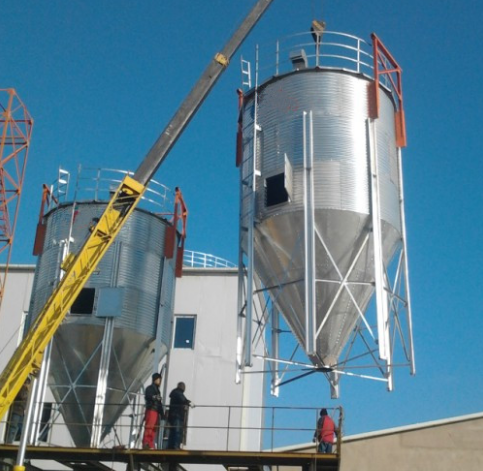
Cone-bottom steel silos feature a tapered base. Material naturally flows toward the discharge port at the bottom, guided by its own weight and the inclined funnel surface. This design is suitable for smaller storage capacities or applications requiring frequent loading and unloading.
Whether you’re in the grain industry or other manufacturing industries requiring large-volume material storage, our steel silos can meet your needs. Simply tell us your requirements, and we’ll design and build a suitable steel silo. We offer one-stop services for agricultural machinery, from plowing, sowing, harvesting, and subsequent processing. If you also require processing machinery, such as rice mills, our extensive product range can significantly reduce your supplier search time.
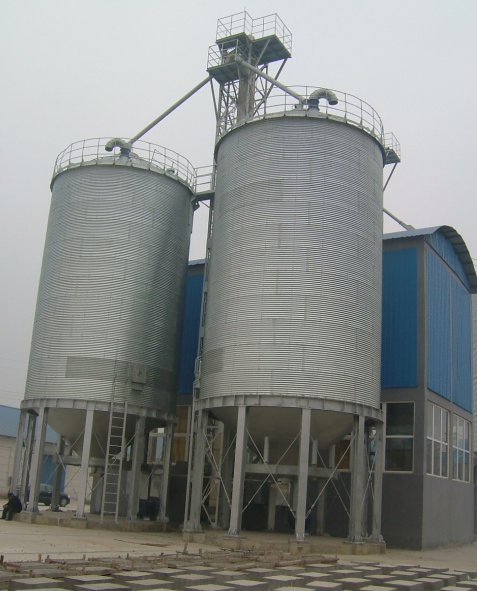
Multiple Capacities Available
ANON steel silos offer single-silo capacities ranging from hundreds to tens of thousands of tons, and can also be combined to form larger storage clusters to meet your different scale needs. Our steel silos feature flexible layouts, supporting various arrangements such as straight lines, triangular shapes, and U-shaped configurations. The direction of the discharge corridor can be customized to your requirements. The vertical silo design helps you achieve optimal space utilization, storing large quantities of materials within a relatively small footprint, thus optimizing space utilization.
Excellent Sealing Performance
ANON steel silos offer superior sealing, effectively preventing pests, moisture absorption, oxidation, and leakage, minimizing material losses and maximizing food security. The top of the silo is equipped with a dust collector, reducing dust pollution and concentration to a minimum, effectively preventing dust explosions and material spills. This enhances the safety of your working environment and meets environmental protection requirements, allowing you to work with peace of mind.
High Automatic Degree
ANON steel silos are highly automated, equipped with automatic material loading/unloading, cleaning, temperature measurement, and ventilation control systems. They integrate ventilation, temperature measurement, material level monitoring, and automatic control for intelligent management, significantly improving operational efficiency. You can remotely monitor silo temperature and material level via computer, and control ventilation and material loading/unloading with a single button, greatly reducing reliance on manual labor and management complexity, while enhancing operational safety and efficiency. Our steel silos can combine natural and mechanical ventilation, reducing energy consumption and making them suitable for storing materials requiring temperature control.
Clean Unloading
ANON steel silos not only have a large capacity but also unload cleanly. Their advanced fluidized discharge system ensures that materials are handled efficiently, with an empty discharge rate of over 95%. Our conical-bottom steel silos allow grain to slide naturally under its own weight and the natural angle of the conical bottom, achieving automatic unloading without auxiliary tools or energy consumption. This results in a high empty discharge rate and virtually no residue. For flat-bottom steel silos, we use a screw conveyor to assist unloading, with a bottom-mounted induction device that makes the material in the bottom area flow like a fluid, allowing it to be discharged from the bottom center outlet under gravity, improving the continuity and thoroughness of unloading. Clean unloading means no material accumulation or spoilage, ensuring your money is used efficiently.
Low Cost
Using ANON steel silos can significantly reduce your costs. Construction time is short, and the weight is only that of the reinforcing steel in a concrete silo of the same capacity. Compared to traditional concrete silos, material costs can be reduced by more than 50%, and land utilization can be increased by 60%, making it especially suitable for users with limited land resources or budgets. Furthermore, the rigid structure of steel silos is stable, and the reinforcing ribs are hot-dip galvanized, resulting in significant economic benefits over long-term use. With proper maintenance, they can last 30-50 years, and with proper anti-corrosion treatment, their lifespan can be further extended, reducing or eliminating the frequency of replacement.
Customized Services
ANON can provide the entire process of design, manufacturing, and installation for your project. You only need to inform us of your storage requirements, land use area, and other detailed requirements, and we can design drawings and produce them according to your specifications. Once the materials arrive at your destination, we will send engineers to handle the subsequent construction and installation, ensuring fast construction and the final quality of the product.
Wide Range of Applications
Our steel silos have a wide range of applications, especially in agriculture, food processing, and manufacturing. In agriculture, they can be used to store grains and feed, effectively preventing mold and pests. In food processing, they can store raw materials and finished products, ensuring food is preserved in a suitable environment. Furthermore, in industries such as chemicals and building materials, they can be used to store various raw materials such as cement and other similar products. Whatever material you need to store, our steel silos can meet your needs.
Flexible Expansion
As your business grows, our bolt-fitted steel silos can be easily expanded or relocated, much like building blocks. Their modular design supports disassembly and expansion. Steel is also a recyclable material, unlike concrete, which cannot be disassembled, moved, or altered once built. This helps protect your initial investment from waste and provides exceptional flexibility for your business’s future development.
FAQ
1. What is the difference between a silo and a warehouse?
Silos store grain vertically, while warehouses store grain horizontally. Using steel silos instead of warehouses for grain storage has many advantages: first, they take up less floor space.
2. What is the service life of a silo?
Grain silos typically have a service life of approximately 30 years or more; therefore, when selecting a grain storage system, thorough calculations should be made and the farm’s actual needs should be fully considered.
3. Are steel silos suitable for very wet mineral powders or explosive grain dust?
Most bulk materials are suitable, but special materials require specialized designs.
For wet materials, the silo walls must be reinforced with corrosion protection, and the design must take into account the material’s angle of repose and flowability; A more robust arch-breaking discharge device must be installed.
For explosive dust, explosion vent panels and necessary safety monitoring systems must be installed, and all equipment must be explosion-proof.
Corrosive materials require a higher-grade anti-corrosion coating or stainless steel.
4. What is the approximate total cost of building a steel silo?
This is a complex question with no standard answer. Cost depends on capacity and size; larger silos are more expensive. Screw silos and prefabricated silos may have lower unit prices, while welded silos may cost more due to the large amount of steel used and complex construction. Supporting systems also determine price. The level of automation (temperature measurement, material level control systems), dust collector, and discharge system selection significantly impacts the total price. Furthermore, foundation and construction conditions: poor geological conditions and remote construction locations can increase costs. It’s usually necessary to inquire with suppliers based on specific plans.
5. What are the key points for steel silo maintenance?
Regular maintenance is essential when using a steel silo. After each filling or emptying, inspect the silo walls for deformation, paying particular attention to areas such as the outriggers. Annually, perform anti-corrosion treatment on the silo walls and inspect the base of the cone bucket for rust. When emptying the silo, verify that the door seals are free of cracks and promptly replace any aging seals. Clean the dust collector on the roof monthly to prevent clogging. Also, monitor the material status in real time using a level meter and temperature sensor. Quarterly, check the air pressure and fluidizing rods in the pneumatic discharge system. Contact us promptly if any abnormalities are detected. This ensures the long-term safe and stable operation of the steel silo.
Contact for detailed service
Anon cooperates with a number of factories to improve efficiency and service quality, and provide technical support and services to customers.
Get Support