



Introduction
When you need to do mowing work, there are many types of mowers to choose from. Have you thought about using a mower that works with a tractor? This can help you get more value out of your tractor. In this article, I’ll introduce four types of mowers that can be used with tractors. If you’re interested, keep reading!
Types of Lawn Mowers for Tractors
Lawn mowers used with tractors can be connected to the tractor either by suspension or towing. The difference lies in whether or not a tractor provides power. Suspension-type lawn mowers require a tractor to drive them, while towed lawn mowers do not require a tractor and have their own wheels.
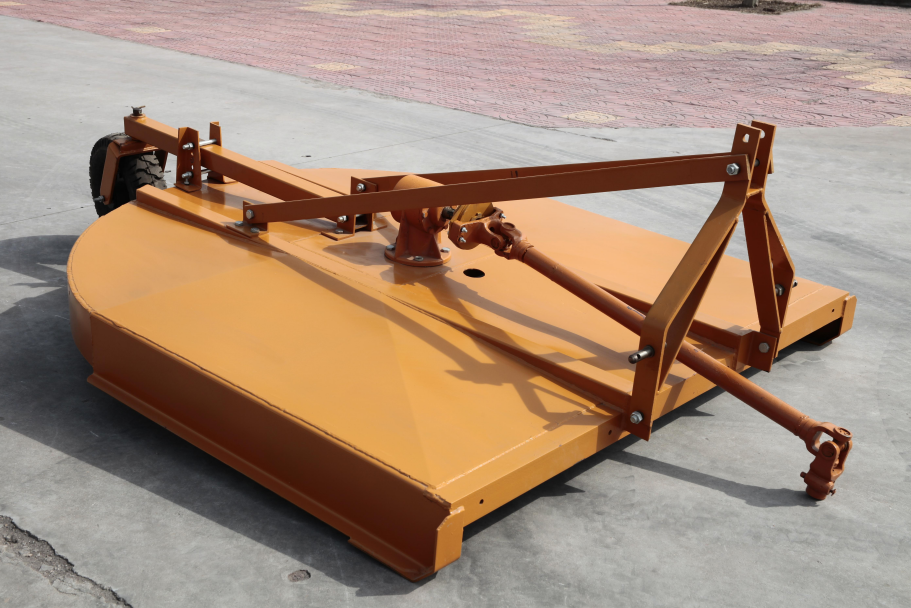
tractor-mounted flail mower
Tractor-Mounted Flail Mower
A tractor-mounted flail mower is a machine that uses fast-spinning blades to cut weeds. Its main working principle is that the tractor powers the mower, sending energy through a gearbox to the blades, which then carry out the cutting. It is powered by a PTO driveshaft. It has a floating link on top and several flail blades. Grass-blocking chains are at the front and back. The blade height is adjustable, and it has four solid wheels at the bottom.
Advantages
High Efficiency
The tractor-mounted flail mower uses fast-spinning blades to cut grass quickly and thoroughly, effectively removing weeds.
Versatility
The tractor-mounted flail mower’s blades come in two-blade or three-blade types, making it efficient and flexible. As I mentioned before, it can be used in various settings.
Safe
The tractor-mounted flail mower is made of aluminum alloy, with thickened blades. The side chains block grass and prevent blade fragments from flying out, making it safer to use while mowing.
Disadvantages
Loud Noise
The tractor-mounted flail mower makes a lot of noise during operation, which can affect people nearby. So, it’s best to use it at the right time and in places where there aren’t many people around.
Land Damage
The tractor-mounted flail mower’s high-speed blades can create vibrations that impact the ground and soil, which may harm soil quality and nutrients. When using the mower, be sure to control the speed and force to avoid excessive damage to the soil.
Uses
The tractor-mounted flail mower is better suited for taller grass, like weeds in fields and along roadsides, and it can even cut shrubs with strong cutting power. Of course, you can also use it on golf courses, sports fields, parks, and schools.
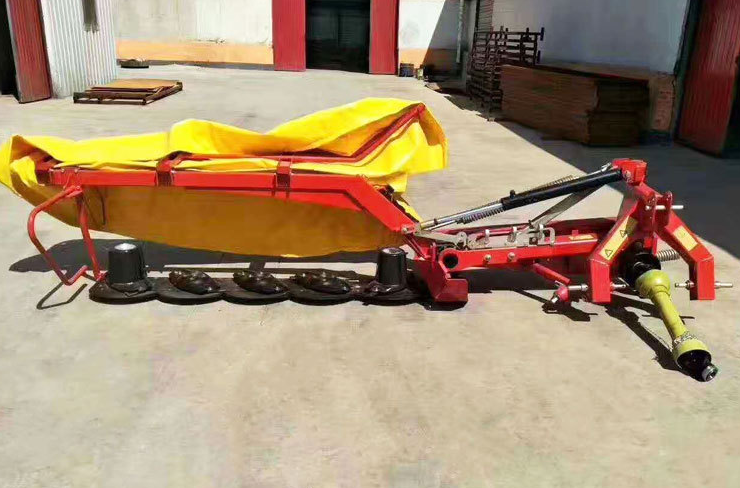
disc mower
Disc Mower
A disc mower, also known as a rotary disc mower, is a widely used machine in agriculture. It is powered by a tractor, and its cutting width varies based on the number of discs. It gets power from the tractor, which is transmitted through a belt to the cutter discs, making the blades spin quickly to cut the grass. Different models of disc mowers have a different number of cutter discs, and each disc has two blades.
Advantages
Low Cost
The discs on the disc mower rotate using gears instead of traditional belts, making the operation more stable. Additionally, the blades can bounce back when they hit obstacles, which helps prevent damage. This means the disc mower has a lower chance of breaking down, and if it needs repairs, they are usually simple and inexpensive.
Adaptability
The disc mower uses spring suspension and a belt-driven design, which allows the cutting bar to be low and easy to raise or lower. This lets it cut closely to the ground for a low cut, and it also follows the ground well.
Disadvantages
Limited
The disc mower is only suitable for trimming soft grasses. For tougher and coarser plants, you will need other specialized machines.
High Power Requirements
The disc mower operates at a high speed, completing about 1 to 2 hectares of work in an hour. However, this high speed requires a powerful tractor to achieve.
Uses
The disc mower has a fast cutting speed and provides an even cut. It is mainly used for trimming various types of grass and other softer plants. The discs are made of aluminum, making them lightweight. Because they can follow the terrain well, they are also suitable for mowing grass on embankments and highway slopes.
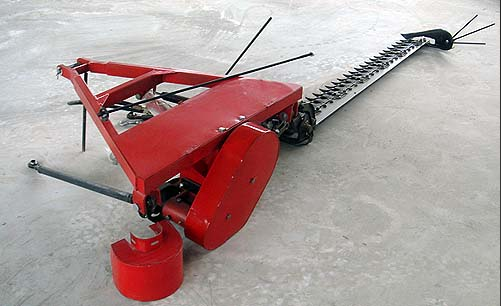
reciprocating mower
Reciprocating mower
The reciprocating mower uses an offset crank and connecting rod mechanism to drive the cutting blades. The blades cut the grass through the relative shearing motion of the moving and stationary blades. It has a simple structure, but still needs a tractor to provide power. It is long and consists mainly of a moving blade and a stationary blade. The moving blade can have either a smooth edge or a serrated edge.
Advantages
Low power requirement
The reciprocating mower requires less power from the tractor—about 80% less than the disc mower. This means you can use a smaller tractor to operate the reciprocating mower.
Land-friendly
The reciprocating mower is lightweight and requires a smaller tractor, so it has less impact on the soil and compaction. When it cuts evenly, it also has a minimal effect on the grass and ground, allowing the grass to recover and grow quickly.
Disadvantages
Regularly check
The reciprocating mower has a simple structure, but when it encounters hard objects like clumps of mud or stones, it becomes difficult to operate. You will need to get off the tractor often to check it. If the grass field is in poor condition, the mowing efficiency will be low.
Low speed
The cutting parts of the reciprocating mower are lightweight, which can cause a lot of vibrations during operation. To keep the mower working properly, the speed should not be too high. The cutting speed of the moving blade is usually less than 3 meters per second, and the forward working speed is generally between 6 to 8 kilometers per hour.
Uses
The reciprocating mower is suitable for flat grass fields, slopes, and hilly areas. You can use it to harvest natural grasses, planted grasses, alfalfa, reeds, and silage feed.
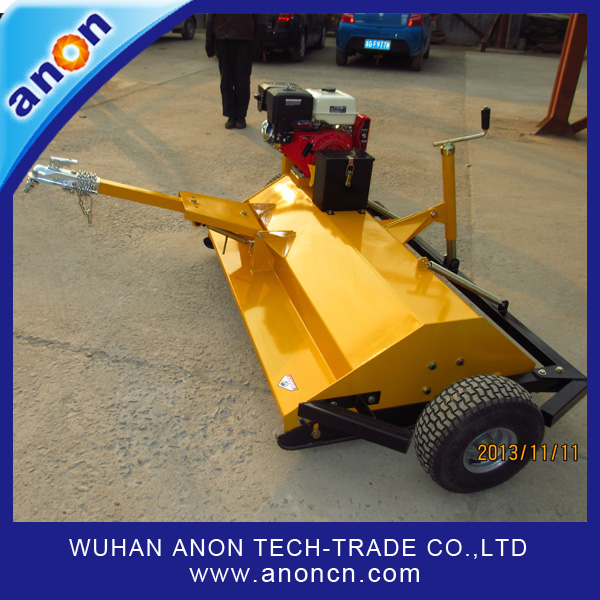
ATV flail mower
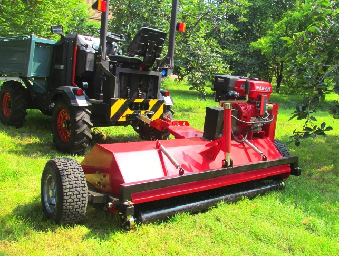
ATV Flail Mower
An ATV flail mower is a specially designed cutting device for all terrains. It combines the mobility of an ATV with the performance of a mower, allowing it to provide good trimming results even on difficult landscapes.It has a compact design, and its size can vary by model to meet different work needs and terrain conditions. Unlike the other mowers mentioned, the ATV flail mower has its own engine, usually a gasoline engine, to provide power. This means the tractor only serves as a towing vehicle for the ATV flail mower.
Advantages
High Efficiency
The ATV flail mower has its own engine for power and comes with wheels, allowing you to complete large mowing tasks in a short amount of time.
Adaptability
The cutting height of the ATV flail mower can be adjusted, allowing you to change the cutting deck according to the height of the grass. This helps achieve better results. Additionally, the ATV flail mower has two types of blades—hammer and Y-shaped—that can be switched out for different applications.
Durability
Because it has its own engine, the overall structure of the ATV flail mower focuses on stability and strength. The connections between parts are solid, and the cutting components are made from high-strength materials, making them hard to damage. As a result, the ATV flail mower is very durable.
Disadvantages
Low Power Requirement
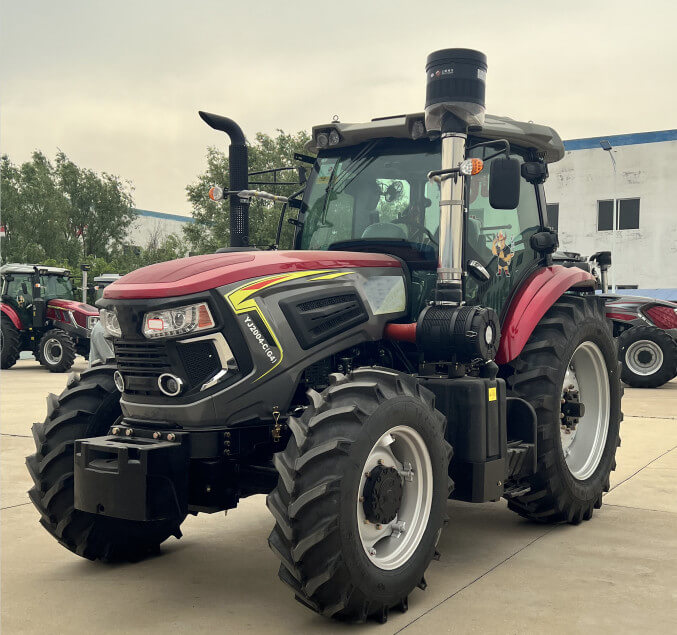
Since the ATV flail mower generates its power, it doesn’t require much power from the towing equipment. For example, a 15 to 20-horsepower tractor, like the ones from ANON, is sufficient.
Limited
Although the ATV flail mower can be used on various terrains, it is not suitable for very steep slopes or marshy areas. In these conditions, the vehicle has trouble moving, and it is difficult to ensure a good mowing result.
High Cost
The structure of the ATV flail mower is quite complex, and it uses high-strength materials, which makes repairs more difficult. As a result, both the production and repair costs are higher.
Uses
The ATV flail mower is highly mobile and can adapt to complex terrains, such as irregular areas, slopes, and hard-to-reach remote places. It’s great for mowing grass in mountains, forests, and orchards. You can also use it on farms, golf courses, parks, and other large open spaces for lawn management.
How to Choose Your Tractor Mower?
Consider Your Terrain
If you need to clear weeds, shrubs, or even saplings in complex terrain, a sweeper mower is the best choice. It’s robust and durable, handles rock impacts well, and shreds vegetation evenly. If you have large flat pastures and prioritize maximum efficiency, a disc mower is the ideal partner. It operates at high speeds and easily handles high-yielding, lodged grass. If your pastures are flat and planted with high-quality forage, and you value a clean cut for high-quality hay and to promote regrowth, a reciprocating mower is a reliable choice. It cuts cleanly and is relatively fuel-efficient. If you need to handle rough, jagged terrain such as riverbanks, roadside slopes, fence edges, and woodland paths that are difficult for tractors to access, an ATV mower (usually a sweeper mower) is ideal due to its unparalleled maneuverability.
Consider Tractor Horsepower
Power matching is crucial; be sure to choose based on the horsepower of your existing or planned tractor. Displacement and large disc mowers typically require higher tractor horsepower to ensure efficient operation and handle heavy vegetation. Reciprocating mowers have relatively lower power requirements. ATV mowers, on the other hand, need to be matched with the traction and driving capabilities of a specific ATV (All-Terrain Vehicle).
Consider your mowing purpose
Clearly defining your core operational objective is key to making the right choice. If your primary activity is harvesting forage (such as alfalfa or rye grass) for haymaking, prioritize cutting quality and efficiency, choosing between disc mowers (high efficiency) and reciprocating mowers (high flatness). If your main purpose is clearing wasteland, shrubs, and weeds, and performing land preparation and maintenance, then a swivel mower or ATV swivel mower offers greater durability and adaptability.
Conclusion
I believe that after reading this article, you have a good understanding of mowers that work with tractors. If you have any questions, feel free to consult us at ANON. We have a variety of mowers for you to choose from, and we welcome you to come and shop!
FAQ
1. How much horsepower does it take to run a disc mower?
Different models of disc mowers require tractors with varying horsepower. Generally, disc mowers need a tractor with at least 35 horsepower, but you should buy a tractor with enough horsepower based on the specific model you choose.
2. Are flail mowers better than rotary mowers?
There’s no inherently “better” between flail mowers and rotary mowers; the best choice depends on the specific application. Flail mowers are better for high-quality, fine, mulching mowing, especially on uneven, rough terrain with potential obstacles like rocks or tree stumps, and they distribute grass clippings more evenly. Rotary mowers are better for quick, rough mowing in long grass, brush, and fields, are less expensive, and are better suited to open, flat areas where a perfectly manicured lawn isn’t the primary goal.
3. How long does a lawnmower last?
The average lifespan of a lawnmower is six years, but with proper maintenance, your lawnmower can last much longer. Simple, regular maintenance can save you money on repairs or purchasing a new machine.
4. Can a rotary mower handle stones?
Unlike rotary mowers, whose blades swing more widely and tend to scatter debris, rotary mowers use a rotating drum with multiple blades connected by flexible joints. As the drum rotates, the blades swing outwards, shredding the vegetation into fine pieces. Key advantages include: safer operation—the blades won’t scatter hidden stones.
5. How big of trees can a flail mower cut?
Flail mowers can cut trees generally up to 2-4 inches in diameter, with heavy-duty models and powerful tractors potentially handling up to 6 inches, depending on hardwood/softwood type, blade sharpness (hammer blades are best), and horsepower; they excel at mulching saplings and brush but struggle with larger, thick trunks, often requiring a dedicated forestry mulcher or shear for anything bigger.