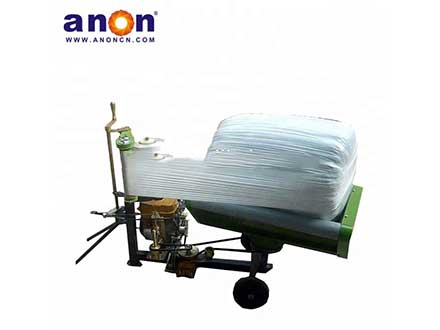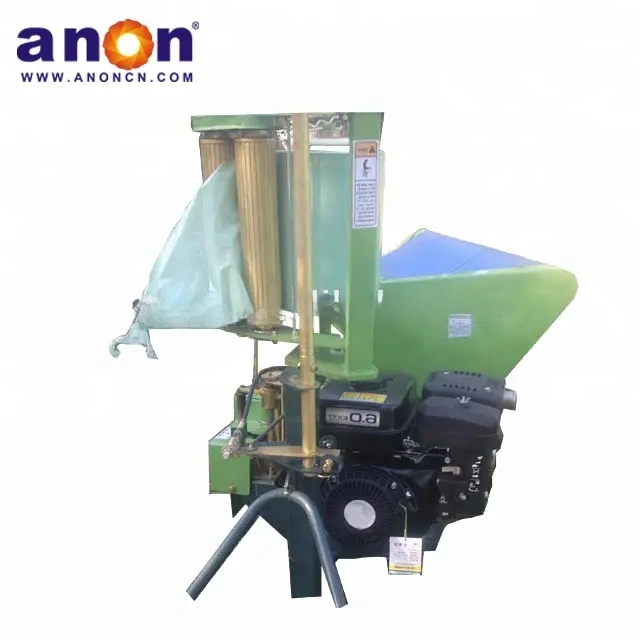



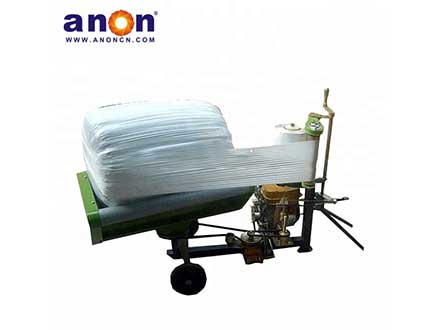
The ANON Mini Hay Baler is a small agricultural machine used to bale and wrap crop residues such as hay and fodder into compact packages. It is suitable for crops such as corn silage, alfalfa, sugarcane tops, sweet potato vines, reeds, and soybean meal silage.
ANON Mini Hay Baler
Working Principle
The mini hay baler is an agricultural machine specifically designed to wrap round bales of hay in plastic film. This process is called baling wrapping. The baler consists of a central rotating arm or turntable that holds and rotates the hay bales during the wrapping process. The turntable is typically driven by a hydraulic system connected to a tractor or other power source. The hay bales are placed on the turntable, and the plastic film is released from a roll mounted on the wrapper. The film wraps around the hay bales as it rotates, forming multiple layers of coverage.
Specification
ANON Mini Hay Baler Features
For family farms and small ranchers engaged in integrated crop and livestock farming, large silage equipment is too expensive, and traditional silage methods are time-consuming, labor-intensive, and wasteful. ANON AN810 mini hay baler understands your difficulties. It’s not just a machine, but a cost-effective and user-friendly mini silage solution, allowing you to produce high-quality silage that can be stored for 2-3 years anytime, anywhere, at a minimal cost.
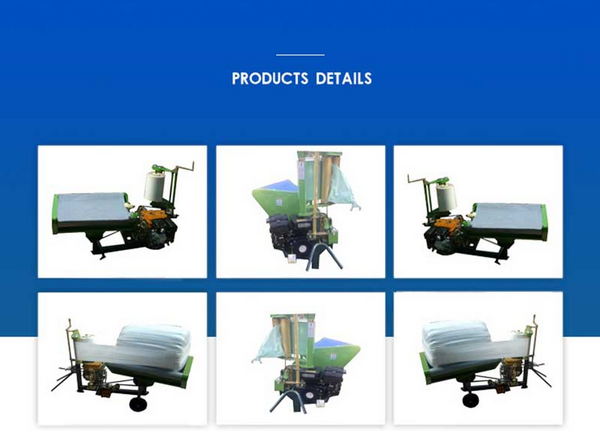
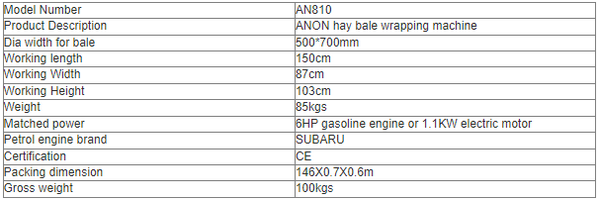
1. The AN810’s design is different from before. The entire machine is like a small toolbox (1.46*0.7*0.6 meters) and weighs 85 kg. This means you don’t need a special trailer; your tricycle can take it. You don’t need a large warehouse; it can fit in a corner of your yard. You can use it anytime, anywhere. The feed processing point can follow the livestock, flexibly accessing scattered hillside pastures or small ranches, completely solving the problem of equipment not being able to fit in the ground, allowing every piece of forage to be directly converted and stored.
2. This machine is specifically designed for mini round bales with a diameter of 61 cm and a width of 70 cm. This matches the bales produced by small balers perfectly and can be moved by a single person. It directly meets the intensive feeding needs of dozens of sheep or several cattle. You don’t need to laboriously handle large bales, nor will you waste feed due to overly large bales. It achieves precise matching throughout the entire process from harvesting and baling to wrapping, ensuring that every portion of feed is used effectively, making it a great helper for intensive farming.
3. We offer two options: a gasoline version and an electric version. The gasoline version (6 hp) is a true field pioneer, requiring no electricity and usable on hillside pastures without electricity; the electric version (1.1 kW) requires only a power connection next to the shed, with low operating costs and quiet, reliable operation. No matter your working environment, the AN810 adapts well. One machine can meet your needs for mobile operations in the field as well as your needs for fixed locations. A single investment can handle all production processes, greatly increasing your business scope and flexibility.
Advantages of ANON Mini Hay Baler
Reliable Performance
The ANON Mini hay baler is a fixed machine for baling and wrapping. Long-term use has proven its performance to be at the advanced level of similar products both domestically and internationally. It is an ideal choice for preparing silage for cattle, sheep, and other livestock. It is not just a machine, but a proven and mature solution. Choosing it means you are getting a dependable way to make good sliage for your animals. Its technology is close to large-scale professional machines.
High-Quality Feed
The silage quality is great when stored. When silage is baled and sealed, there is no waste or mold, which greatly reduces feed loss due to sap runoff. Animals can use almost 100% of it, while traditional silage suffers losses as high as 20%-30%. It keeps the nutrients locked in from the source, which almost gets rid of waste from mold and sap runoff. This means that every ton of forage you input can be more efficiently turned into energy for animal growth, directly turning saved feed costs into extra money.
Good Sealing Performance
The ANON mini hay baler uses a specially designed, stretchable plastic film for wrapping the bales. This makes a strong seal that stops moisture and air from getting in. It is highly durable, able to withstand handling and transportation without tearing or breaking. This special film sticks to the bale like skin, creating a smooth seal and strong resistance to moisture, air, and damage during transport. This ensures that the quality of the feed inside remains stable no matter the weather or how it’s handled.
Easy to move
The ANON Mini hay baler is suitable for bales produced by small round balers (such as the 850 and 870 models). Equipped with a gasoline engine, it is easy to move in the field. It pairs perfectly with your existing or mainstream small balers to form a smooth production line.
With its own gasoline power, no external power source is required, giving you a mobile processing plant that can be deployed to any corner of the pasture at any time, offering maximum freedom.
Great for Storing Forage
Wrapped straw stays good for a long time. It doesn’t spoil easily, get squashed, or get ruined by the weather. Plus, it’s simple to move around and lasts for 2-3 years outside, which means you don’t have to stress about storage space or the farming seasons.
Forget about mold in the rain or running out of food in the winter. You also won’t need to pay for pricey warehouses. This way, you can keep your feed safe and use it when you need it, making things much easier.
Simple to Use
It’s easy to use. Anyone can pick it up quickly, even if they’re not a pro. We got rid of all the complicated stuff, so using this silage tech is like using a regular machine at home.
You don’t need special skills. People can use it on their own in no time, which cuts down on the need for experienced workers.
Simple Structure
This machine has a simple build, small size, and keeps running and upkeep costs down. The simple build means less can go wrong, and repairs cost less. Its small size saves space when storing and moving it. From buying to using it for years, its design helps you manage total ownership costs, making it a money-saving choice.
Light and Easy to Move
ANON mini hay balers are small and light, so they’re easy to carry and move. They work well for small farms, family farms, or ranches. One person can move them around small fields, hills, or farmyards where bigger machines can’t go. They fit the modern, small farm style, letting you make your own animal feed on every bit of land.
Conclusion
To wrap up, the ANON AN810 mini hay baler is a key step toward making your own good silage, so you don’t have to buy feed or store a lot of it. It doesn’t need much room, can use different power sources, and fits the scale you need. It tackles the big issues of cost, space, and know-how.
ANON Our Services

FAQ
1. What are some common problems with hay balers?
Improper pickup adjustment can lead to low hay collection efficiency, uneven feeding, and blockages. Misalignment of components in the feeding system can prevent hay from being properly fed into the baling chamber, causing blockages between the pickup wheel and the belt.
2. Is it okay to harvest hay in October?
Hay harvested in October is typically rich in nutrients and of excellent quality. Laboratory tests show that the crude protein content of this hay often exceeds 25%, and its relative feed value often exceeds 200. The fine stalks of hay can be tightly bundled into sturdy, heavy bales. However, hay harvested in October is also difficult to dry.
3. How long can hay be left after harvesting before baling?
Usually, it’s baled on the third day, but this depends on the weather. We’ve also baled it on the second day in very dry weather. Usually, the hay needs to be turned over on the second day. Generally, it can be turned over two days after harvesting.
4. Why do you bale hay at night?
We often bale alfalfa hay at night because it needs a certain level of moisture, around 12% to 15%. This extra moisture helps soften the hay, making the bales easier to compact because the leaves won’t fall apart. After baling, we let them dry in the sun for a while before feeding them to the livestock.
5. Why do farmers leave hay bales in the fields?
Farmers leave hay bales in the fields for storage, convenience, and to make future use or transportation more economical. If there isn’t time or space to immediately move the hay bales indoors, they are usually left in place because the hay can be fed directly to livestock, especially in winter. Hay bales can be arranged along the edge of the field and sometimes covered to protect them from wind and rain until needed or moved to a more permanent storage location.
Related Products
Anon China Tractor Mounted Round Straw Hay Baler Machine