



Best Tractor for Small Farms: How to Choose the Right Size and Horsepower
There is no single best tractor for every small farm. The right choice depends on your crops, primary applications, terrain and soil conditions, implements, farm size, and required horsepower.
Assessing Your Needs
Tell me about your farm, and I’ll tell you what kind of agricultural tractor you need.
Q1: What Crops Do You Grow?
The best tractor for a small farm depends on what you grow and how your farm is set up.
Vegetable farming
requires a versatile tractor with wide implement compatibility for tasks such as tilling, planting, cultivating, and spraying
Grain farming
requires better traction and appropriate horsepower for plowing, harrowing, tilling, planting, fertilizing, spraying, and transportation.
Orchard farming
requires a maneuverable walking-behind tractor or compact tractor that can easily operate between rows for fertilizing and transportation.
Livestock farming
requires a versatile front loader tractor with sufficient PTO power, hydraulic capacity, and loader capacity for hauling, hay handling, manure management, and livestock feeding.
Rice or Paddy farming
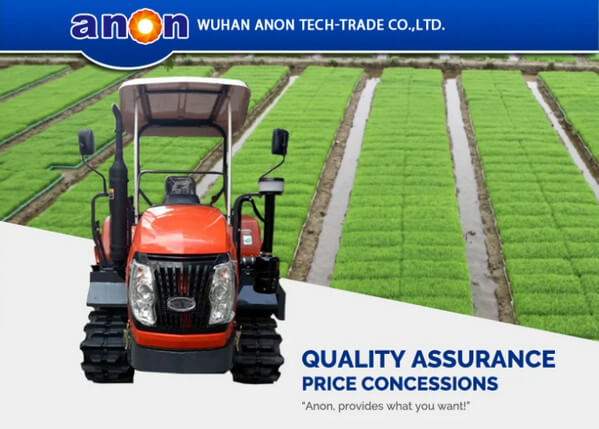
Requires a boat tractor or crawler tractor with lower ground pressure that can work efficiently in soft, wet, and muddy soil conditions.
Mixed farming
Requires a utility tractor that has a balanced size, traction, and wide attachment compatibility to cope with different farming tasks.
Q2: What Tasks Will You Perform?
You also need to consider the size of your farm. If your farm is too small and the tractor is too large, it can waste resources on maintenance and fuel, and storage space can be an issue. Moreover, oversized tractors on smaller farms may compact the soil and damage crops, affecting their growth.
If you have a large farm but purchase a small tractor or medium tractor, although they are flexible, they will require more time and effort for the same workload compared to a large tractor, resulting in lower efficiency. Additionally, small and medium-sized tractors have limited working ranges, which can lead to uneven operations.
Q3: What Terrain and Soil Conditions Will You Work In?
If your land condition is a flat, open field, typically any tractor should be appropriate. You can choose the features based on other farming needs. However, if your land condition is more challenging, please read on to find the tractor features for better tractor performance.
- Hilly terrain and uneven terrain: to operate smoothly on these fields, a four-wheel drive system is essential. A 4WD tractor could provide more traction and stability when passing over slopes and obstacles.
- Muddy & Soft soil: a wider tire configuration can provide sufficient traction while reducing damage to the soft soil.
- Paddy fields: when operating in paddy fields, it requires the ability to float over the fields. A crawler tractor or boat tractor can travel easily.
Q4: What Is Your Budget?
Finally, you need to consider your budget range, which not only includes the cost of purchasing the machine, but also takes into account long-term maintenance, fuel consumption, and accessory investment issues. Within the budget, purchasing the most cost-effective machines can help with long-term operations.
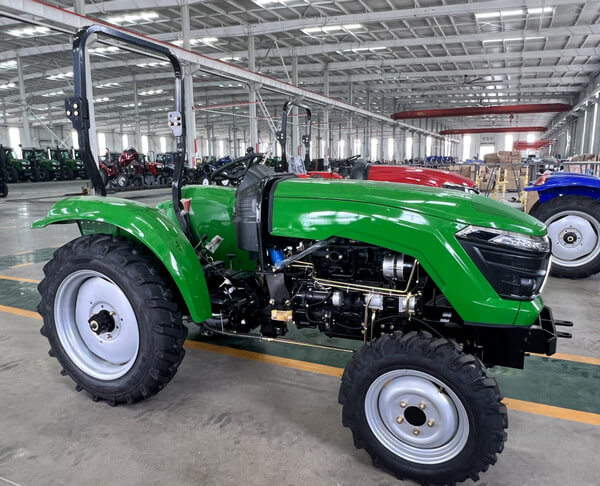
wheeled tractor
What Tractor Specifications Should You Look For?
This is the core element you need to consider when making decisions. When selecting a tractor, it is important to compare these key features.
Horsepower
When choosing a tractor, it’s important to understand its horsepower. Remember the small tractors, medium tractors, and big tractors I mentioned? They’re categorized by horsepower: Tractors with less than 20 horsepower are small tractors, those between 20 and 50 horsepower are medium tractors, and those over 50 horsepower are big tractors. Generally, higher horsepower means higher efficiency. Horsepower measures the tractor’s output power, calculated by Horsepower = Torque × RPM ÷ 5252. Torque, or rotational force applied to an object, is a key factor in horsepower. So, with the same weight, more horsepower means faster speed and stronger load capacity. For most small-scale farms, such as plowing and mowing, a 20-50 horsepower tractor is already sufficient, while a high-powered tractor is a bit beyond the standard in terms of price and functionality.
Size
Small farms usually have narrow spaces, so the size of the tractor also needs to be measured to ensure good passability in the field. Tractors with smaller dimensions have compact bodies and smaller turning radii, making them more adaptable to small plots of land. Of course, the size and horsepower of the tractor are also related, so you not only need to evaluate the external dimensions, but also ensure that the horsepower of the tractor can meet your needs.
Tractor Type
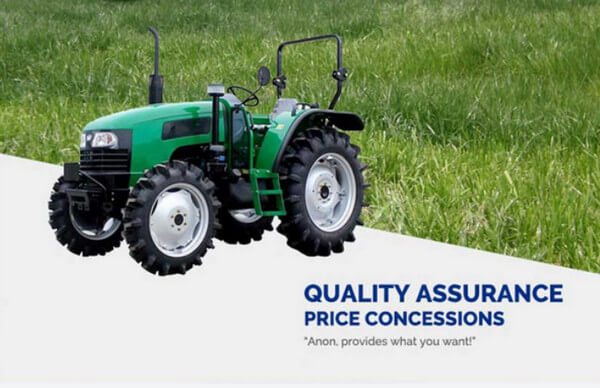
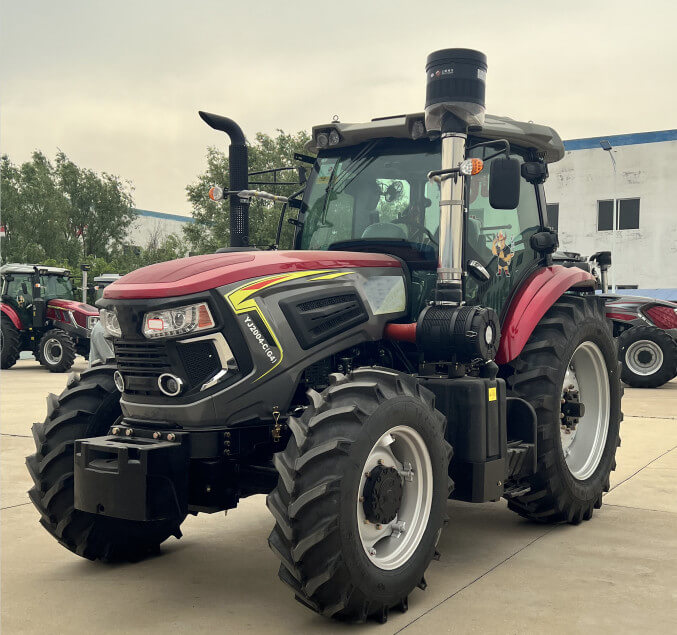
There are various types of tractors, including wheeled tractors, tracked tractors, hand-held tractors, and boat tractors. You can choose according to the condition of your own farmland. If it is a paddy field, terraced fields can consider using hand-held tractors such as mobile phones and boat tractors; In hilly areas, if the land is uneven or muddy, a tracked tractor can be chosen, while if it is dry land or larger land, a wheeled tractor can be considered. When choosing a wheeled tractor, you need to understand the drive type(2WD and 4WD). It’s not just walking tractors that are two-wheel drive. Some tractors have four wheels, but only the front or rear wheels provide power and traction, also called two-wheel drive. Only tractors where all four wheels provide power and traction are four-wheel drive. Two-wheel drive tractors are more flexible, easier to maneuver, simpler, and cheaper. Four-wheel drive tractors offer better traction and stability, making them suitable for complex terrain and tough working conditions.
Tractor Functions
Choosing a tractor that can easily attach multiple agricultural tools can greatly improve the utilization rate of your tractor and achieve multi-purpose use of one machine. For example, tractors can be connected to rotary tillers, seeders, weeders, harvesters, trenchers, and other agricultural functions. Most tractors have rear attachment points, mainly used for towing agricultural tools and power drives. However, some tractors can also be equipped with front attachment points, which are used to connect loaders, buckets, forks, etc., mainly for lifting and handling functions.
Engine Types
The engine is the tractor’s power unit, converting heat energy from fuel combustion into mechanical energy to drive the tractor during operations. Engines are categorized by fuel type into diesel engines and gasoline engines. Explaining only the tractor engine components might be hard to understand, so I’ll compare them below to clarify their differences and help you make a better choice.
Ignition Method
Gasoline has a high ignition point, is easily volatile, and has a compression ratio (degree of gas compression) between 7-13, so it uses spark plug ignition. Diesel has a low ignition point, is not easily volatile, and has a compression ratio between 16 and 24, so it uses compression ignition.
Load Capacity
Diesel engines draw in a larger volume of air, burn fuel more completely, and produce higher pressure. Moreover, because diesel is not easily volatile and uses compression ignition, it burns more slowly and has a longer stroke compared to gasoline engines. As I mentioned before, torque relates to force and force arm, so you can see that diesel engines have higher torque. Diesel engines have superior load capacity compared to gasoline engines.
Speed
Due to the excessive pressure generated and the long stroke of diesel engines during operation, high engine speeds can cause violent impacts on internal parts, so diesel tractors generally cannot operate at too high speeds. On the other hand, gasoline engines ignite fuel with spark plugs, making combustion faster and operations quicker, resulting in greater power output. Although gasoline engines have lower torque, they operate at higher speeds, so gasoline tractors are faster than diesel tractors.
Economy
Before discussing the economy of diesel and gasoline engines, you need to understand the power calculation formula: Power = Torque × RPM ÷ 9550. You’ll see that when diesel and gasoline engines have the same power output, gasoline engines consume more fuel than diesel engines. Diesel engines have higher manufacturing costs due to the high precision required for certain parts. Gasoline engines, on the other hand, have electronic components, making their maintenance costs higher than those of diesel engines.
Engine Cooling Methods
Whether it’s a diesel engine or a gasoline engine, a lot of heat is generated during operation. If not cooled promptly, it can damage engine parts. The two common cooling methods are air cooling and liquid cooling. Both of these cooling methods use water as the cooling medium. The difference is that it uses water evaporation to dissipate heat, which requires constant replenishment; Another way is to circulate the coolant through a pump. The coolant is then cooled by the airflow of the moving machine or fan. If your work area is close to a water source, you can choose water cooling. Generally speaking, water cooling is more stable.
Easy to Use and Maintain
The quality of a tractor is not only reflected in its various components but also in the overall material of the machine, which determines its durability, lower failure rate, and ability to cope with high-intensity use. When choosing to purchase, it is even more important to ensure the supply of accessories, which facilitates subsequent maintenance.
New and Used Tractor
Between purchasing a new machine and a used tractor, if your budget is limited but you want to buy a tractor that is worth the price, then buying a used tractor is a cost-effective choice. However, when buying a used tractor, you need to find a reliable dealer who has a clear understanding of the wear and tear of the machine and its usage before making a decision. Considering long-term use and quality assurance, a brand-new tractor will definitely not disappoint you.
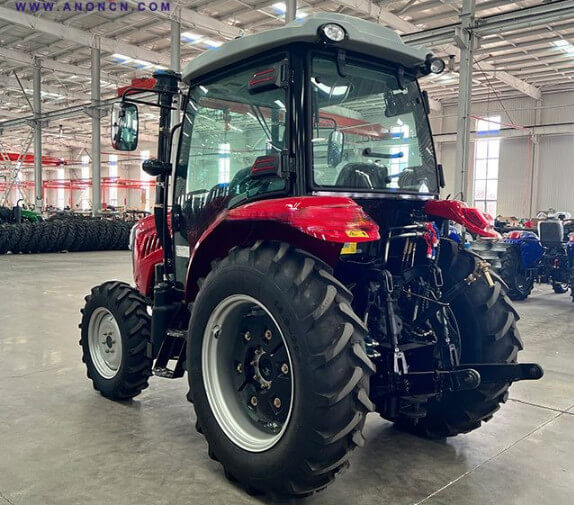
How to Choose a Reliable Agricultural Tractor Supplier?
Key things to consider when sourcing a reliable agricultural tractor supplier
1. Does the supplier offer the right product range for your needs?
2. Is the supplier an experienced manufacturer?
3. Does the tractor supplier customize the product to your requirements?
4. Can the supplier match the tractor to your implements or provide a one-stop solution?
5. Does the supplier provide a reliable warranty and spare parts to your region?
6. Does the supplier offer long-term after-sales and technical support?
Connect with ANON
I believe that after my introduction, you should have some ideas on how to choose a tractor. You can pick the best tractor for your small farm based on your conditions and budget. ANON has been established for 20 years, specializing in exporting agricultural machinery. We have a wide variety of tractors and matching implements, so you can choose some implements to use with your tractor.
FAQ
What size tractor do I need for my farm?
For larger farms, you’ll need a tractor with a power setting of 100 horsepower or higher, with 200 or 300 horsepower being ideal. You’ll also need to consider the terrain: if your terrain is rocky and sloping, you’ll need a more powerful tractor than if your farm is on flat ground.
When is the best time to purchase a tractor?
The best time to purchase a tractor depends on your priorities: in order to obtain the best cash transactions and choices, the goal is to switch from old inventory to new models in the late autumn after harvest (November December); In order to obtain the widest variety and early season financing, the goal is early spring (January to February); During the off-season (August to October), there is less demand and negotiations are better, while trade shows provide incentives for specific brands.
How big is a 10-acre tractor?
For 10 acres of land, compact tractors in the range of 30-50 horsepower (HP) are usually very suitable for general tasks such as mowing, towing, and light tillage, but if you have heavy agriculture (hay, heavy cleaning), multi-purpose tractors with 50-60 horsepower or more are better; Always consider your specific household chores (loader work requires increased capacity, lawn mowing requires PTO power) and terrain.
How to choose between two-wheel drive and four-wheel drive?
The key to choosing between two wheel drive or four-wheel drive is to balance cost and performance requirements: two wheel drive is cost-effective and suitable for routine operations on flat, dry, and hard surfaces; Although the purchase cost of four-wheel drive is relatively high, it can provide excellent traction and stability, especially when dealing with complex terrains such as slopes, muddy or slippery terrain, greatly expanding the operating range and improving safety. It is a better choice for handling constantly changing terrain or high-intensity multifunctional operations.